
Are you considering IVF or egg freezing in the Philippines but unsure when to start?
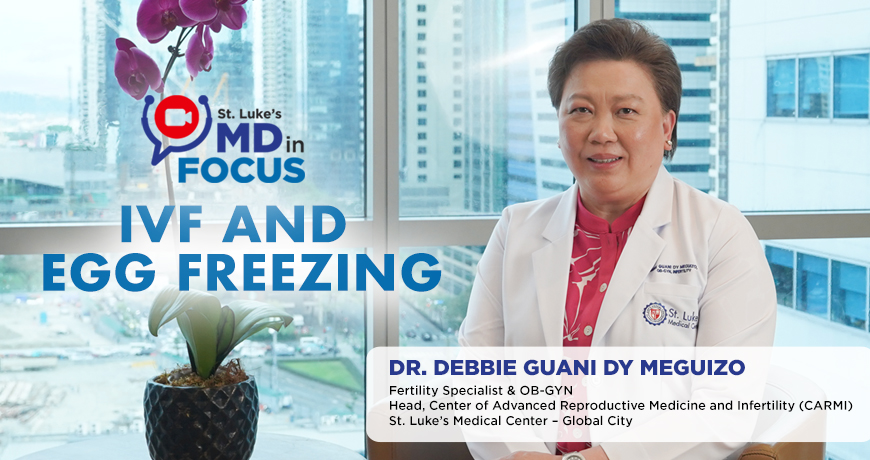
An Expert's Insights from St. Luke’s Center for Advanced Reproductive Medicine and Infertility (CARMI) Head, Dr. Debbie Guani-Dy Meguizo, on Taking Control of Your Fertility
“Maybe someday.”
For many women, that’s how the conversation around having children begins. But as time passes, “someday” can become more complicated—especially when fertility naturally declines with age.
Today, advances like in vitro fertilization (IVF) and egg freezing (oocyte cryopreservation) are giving women more control over their timelines. But when is the right time to consider these options?
According to Dr. Debbie Guani-Dy Meguizo, Head of the St. Luke's Center for Advanced Reproductive Medicine and Infertility (CARMI), the answer is “It’s my pleasure to help women understand IVF and egg freezing—and to encourage doing it early.”
Modern lifestyles have reshaped how women approach relationships, careers, and family planning. As a result, more individuals are turning to fertility preservation in the Philippines to keep their options open.
Dr. Meguizo emphasizes that awareness is key: “Fertility is not something we should think about only when we’re ready to have a baby. It’s something we should understand early, so we have more options later.”
This shift—from reactive to proactive care—is redefining reproductive health today.
What Is IVF and How Does It Work?
In vitro fertilization (IVF) is a highly advanced fertility treatment where eggs are fertilized with sperm in a laboratory. The embryo is then transferred into the uterus to achieve pregnancy.
For many patients, IVF represents hope. IVF gives hope to couples who may have difficulty conceiving naturally. With the right guidance and timing, it can significantly improve the chances of pregnancy,” shares Dr. Meguizo.
IVF is often recommended for:
- Couples struggling with infertility
- Women with blocked fallopian tubes
- Male factor infertility
- Unexplained fertility challenges
With continuous technological advancements, IVF success rates are improving—especially with early intervention.
What is Egg Freezing?
Egg freezing (oocyte cryopreservation) allows women to preserve healthy eggs for future use—essentially “pausing” their biological clock.
But timing is everything.
“The earlier you freeze your eggs, the better the quality. That directly impacts your chances of success in the future,” explains Dr. Meguizo.
This option is ideal for women who:
- They are not yet ready to start a family.
- Want to prioritize career or personal goals.
- Have not found the right partner yet
- Are undergoing medical treatments that may affect fertility
Dr. Meguizo adds, “Egg freezing allows women to preserve their fertility while they focus on other priorities—without closing the door on future motherhood.”
One of the most important—but often misunderstood—facts about fertility is how strongly it is linked to age.
Women are born with a finite number of eggs, and both egg quantity and quality decline over time, particularly after age 35.
Dr. Meguizo underscores this reality, “The biggest factor affecting fertility is age. That’s why early planning gives you more options and better outcomes.”
This is why fertility experts encourage women to start conversations early—even if pregnancy is not yet in their immediate plans.
Fertility care today is no longer just about treating infertility—it’s about empowering choice.
From IVF to egg freezing, women now have access to tools that allow them to:
- Plan Parenthood on their own timeline
- Reduce anxiety around age-related fertility decline.
- Make informed, confident decisions.
As Dr. Meguizo puts it, “These technologies are here to support women—not just medically, but in giving them the freedom to choose their own timeline.”
Why Choose St. Luke’s CARMI for IVF and Egg Freezing?
The St. Luke's Center for Advanced Reproductive Medicine and Infertility at St. Luke’s Medical Center is one of the leading fertility centers and the only hospital-based in the Philippines, offering comprehensive and personalized reproductive care.
Here, patients receive:
- Advanced IVF and egg freezing technologies
- Expert fertility specialists
- Individualized treatment plans
- Compassionate, patient-centered support
Every step of the journey is guided by both science and empathy—helping patients feel informed, supported, and confident. Here is the list of Frequently Asked Questions About IVF and Egg Freezing that may help you.
When should I consider egg freezing?
The best time is typically in your late 20s to early 30s, when egg quality is highest. However, it’s best to consult a fertility specialist for personalized advice.
Is IVF only for couples with infertility?
No. While IVF is commonly used for infertility, it can also be an option for individuals who want assistance in achieving pregnancy due to various medical or personal reasons.
How successful is egg freezing?
Success depends largely on the age at which eggs are frozen. Younger eggs generally result in higher success rates when used later.
Is fertility testing necessary even if I’m not trying to conceive yet?
Yes. Early fertility assessment can help you understand your reproductive health and plan ahead.
Your future family may still feel far away—but the choices you make today can shape your options tomorrow.
Whether you’re exploring IVF in the Philippines, considering egg freezing, or simply want clarity about your reproductive health, expert guidance is key.
As Dr. Meguizo reminds every woman:
“Don't wait too long, 'cause the quality of these eggs deteriorates as you get older. So we should not settle for less. We don't settle for anyone. We don't settle for anything less. But you have to settle for the best, and the best will mean to freeze your eggs early.”
“The earlier you understand your options, the more empowered you are to make the right decision for yourself.”
Start your journey with confidence. Consult with St. Luke’s CARMI today.


